Rethinking Effort and Human Life
“A being is born alone and dies alone.” — Garuda Purana
Yet humans have always organized themselves into groups. From tribes to kingdoms, from empires to modern nation-states, societies formed for protection, cooperation, and survival. Over time these structures evolved into complex hierarchies and systems of thought—political ideologies, economic models, and countless “isms” attempting to define how humans should live together.
Despite centuries of experimentation, we still struggle with a fundamental question: does society exist to serve the individual, or does the individual exist to serve society? At the root of this tension lies a deeper problem. Humanity has never agreed on a universal and natural way to measure human effort.
In early societies, effort was exchanged through barter. Later came currencies made of metals, paper money backed by institutions, and eventually digital balances recorded in financial systems. All of these are attempts to measure and exchange effort. Yet they remain abstractions—symbols that stand in place of real human life.
Yet the rhythm of human life itself has never changed. Life unfolds moment by moment, breath by breath. Every action—thinking, speaking, building, creating—draws from the same underlying rhythm of existence.
What if the most honest unit of human effort was not gold, paper, or digital numbers—but breath itself?
Breath as the Fundamental Unit of Life
Breath is the most immediate expression of life. Every human shares it. Every moment of activity consumes it. Unlike money, breath cannot be stored indefinitely or accumulated beyond the limits of life itself.
Ancient Indian traditions observed that a healthy human breathes roughly 21,600 times in a day. Over a theoretical lifespan of 120 years, this corresponds to approximately 946 million breaths in a lifetime.
| Unit | Relation | Approximate Time |
|---|---|---|
| 1 Prāṇa | One breath cycle | ~4 seconds |
| 6 Prāṇa | 1 Vināḍī(Pala) | ~24 seconds |
| 60 Vināḍī | 1 Nāḍī(Ghati) | ~24 minutes |
| 60 Nāḍī | 1 Day–Night | ~24 hours |
In this view, time itself unfolds through breath and life becomes the gradual expenditure of these breaths.
Breath and Free Will
Most biological processes operate beyond conscious control. The heart beats, blood circulates, and cells regenerate automatically. Breath is unique because it lies at the intersection of automatic life processes and conscious control.
Life provides the breaths.
Time counts them.
But the mind decides how they are spent.
Breath as Currency
If breath represents life expenditure, it can also serve as a natural unit for measuring human effort.
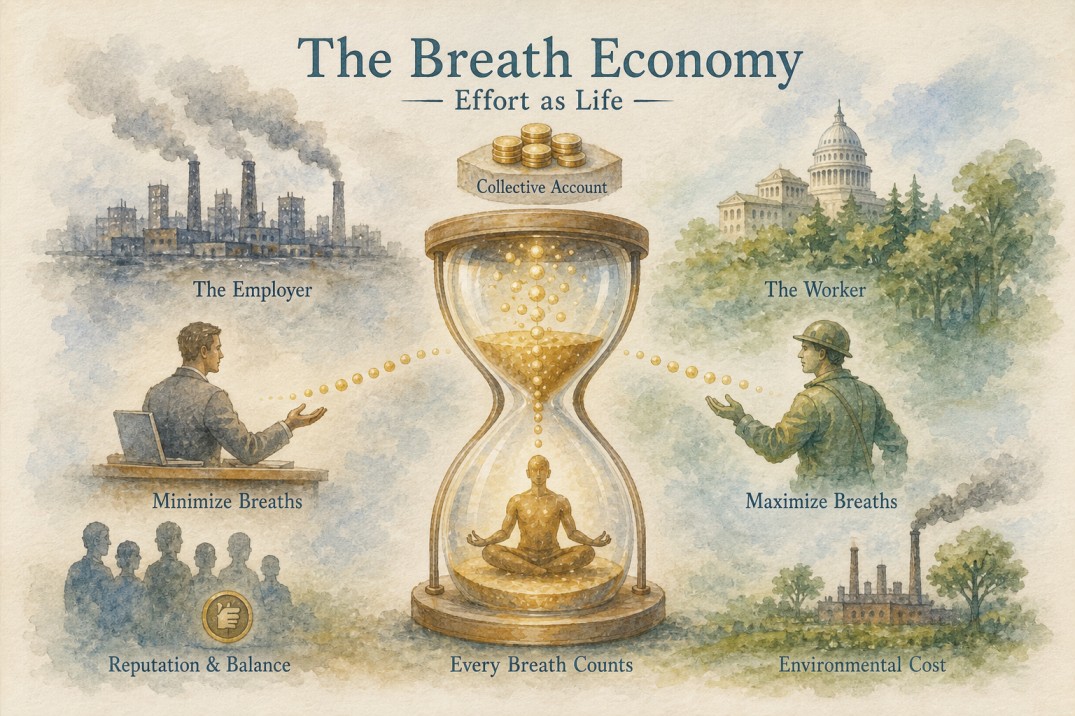
In a breath-based economy each individual maintains a breath account. When a person needs work done, they describe the task and the skills required. Workers perform the task, and the breaths expended during the work become the payment request. These breaths are transferred from the employer’s account to the worker’s account.
- Employers prefer workers who complete tasks with fewer breaths.
- Workers improve their skills to perform tasks more efficiently.
- Reputation becomes the primary driver of opportunity.
Entry Support and Collective Accounts
Young individuals entering the workforce may lack experience or reputation. Governments or communities can provide limited incentive breaths so that new participants remain competitive.
Unlike modern fiat systems, no authority can create breaths arbitrarily. Every breath distributed by governments must come from a collective account funded by real contributions from society.
Environmental Implications
Environmental damage increases the effort required to sustain life. If polluted cities require more breaths to clean streets, filter water, or maintain infrastructure, society must expend more life energy.
In this framework protecting nature becomes economically rational because it reduces the breaths required for survival.
Nations and Cooperation
When measured in breaths, large-scale conflicts such as wars become visibly irrational. War consumes enormous human life energy and requires even more breaths for reconstruction.
International cooperation therefore becomes the more efficient path for human civilization.
Common Questions
Is breathing rate too variable to measure effort?
Actual breaths expended during a task are measured. Over time large datasets allow governments to maintain baseline breath estimates for common tasks.
Can people game the system by breathing more?
Workers who artificially inflate breath expenditure become inefficient and lose future work opportunities as employers prefer more efficient individuals.
What happens to breaths after death?
Remaining breaths return to the collective system pool. They are not inherited, preventing generational accumulation of wealth.
What about thinking jobs vs physical jobs?
All work consumes breaths. Education and training themselves require large breath investments, allowing skilled individuals to perform specialized work efficiently.
Are loans possible?
Traditional loans are avoided. Breaths represent life expenditure and should not be borrowed from the future.
How are job expectations estimated?
Governments can maintain baseline breath estimates for common tasks to guide employers when requesting work.
Can accounts go negative?
No. Overdrafts are not allowed. Work must be backed by an existing breath balance.
Conclusion
Human societies have long searched for systems that measure effort and organize collective life. Most rely on abstractions increasingly detached from the reality they represent.
Breath returns us to that reality.
Every action consumes a portion of our finite life. If effort and value are understood through breaths spent, our priorities may gradually shift toward balance, cooperation, and meaningful contribution.
Between birth and death lies only a finite number of breaths.
How we spend them ultimately defines both our lives and the
societies we build.