What this page is trying to answer
My Bharat is a civilizational design note: why a society needs Bharat, what Bharat should protect, and how governance can move from slogans to accountable systems.
The aim is a society guided by Dharma, rooted in nature and cultural memory, but operated through clear responsibility, transparent budgets, and local execution.
Why Bharat
Human beings first gather for survival, then organize into tribes, kingdoms, nations, and data-driven global systems. A nation is not only land or administration; it is a stable container for shared memory, duty, justice, and continuity.
Bharat is needed because society cannot be reduced to markets, elections, or global supply chains. It needs a deeper purpose: to help life flourish without exploitation and to keep human ambition aligned with Dharma.
Territorial integrity and stability
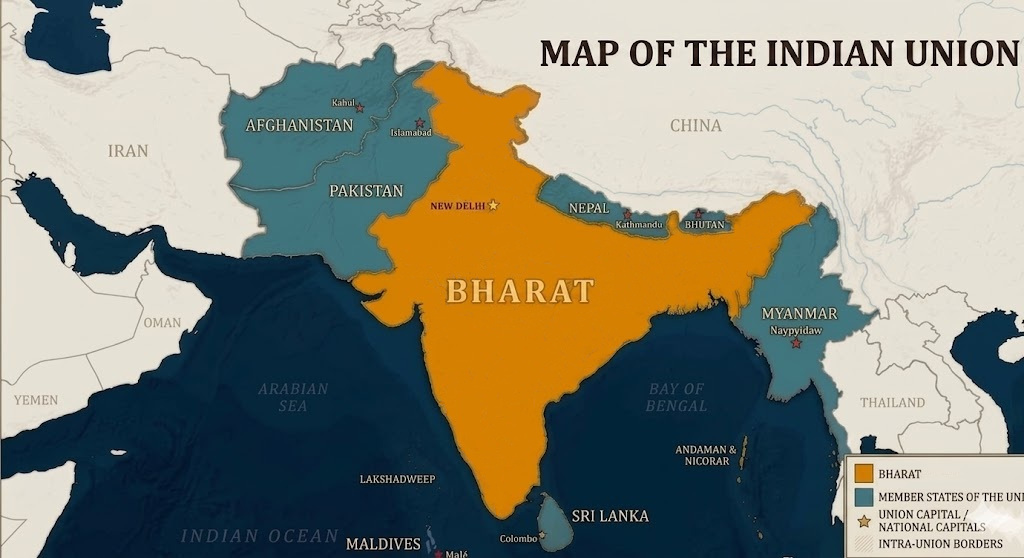
A stable Bharat needs a clear territorial imagination. The union is not merely a border on a map; it is the physical frame in which culture, economy, defence, ecology, and governance remain connected.
How Bharat should govern
- Centre: defence, economy, foreign policy, interstate infrastructure, science.
- State: cultural and geographic localisation of national policy.
- District: coordination across executive, legislative, and judicial functions.
- Ward: daily implementation, local services, schools, health, drains, housing, and complaints.
How to make it accountable
- NCR: a national complaints register where every citizen issue is logged, routed, tracked, and visible.
- NBR: a national budget registry where public money is tied to needs, complaints, projects, and outcomes.
- Oversight body: an independent immune system that audits quality, detects collusion, and keeps transparency real.
- Demand-supply planning: education, health, workforce, and infrastructure capacity driven by projections, not frozen quotas.
Path to Bharat
The transition should begin with systems that improve daily life without waiting for a complete constitutional redesign: pilot NCR and NBR, clarify ward accountability, and make budgets visible.
The longer path is to define citizen duties, culture and language responsibilities, defence and environment frameworks, and a clean division of responsibility across centre, state, district, and ward.